
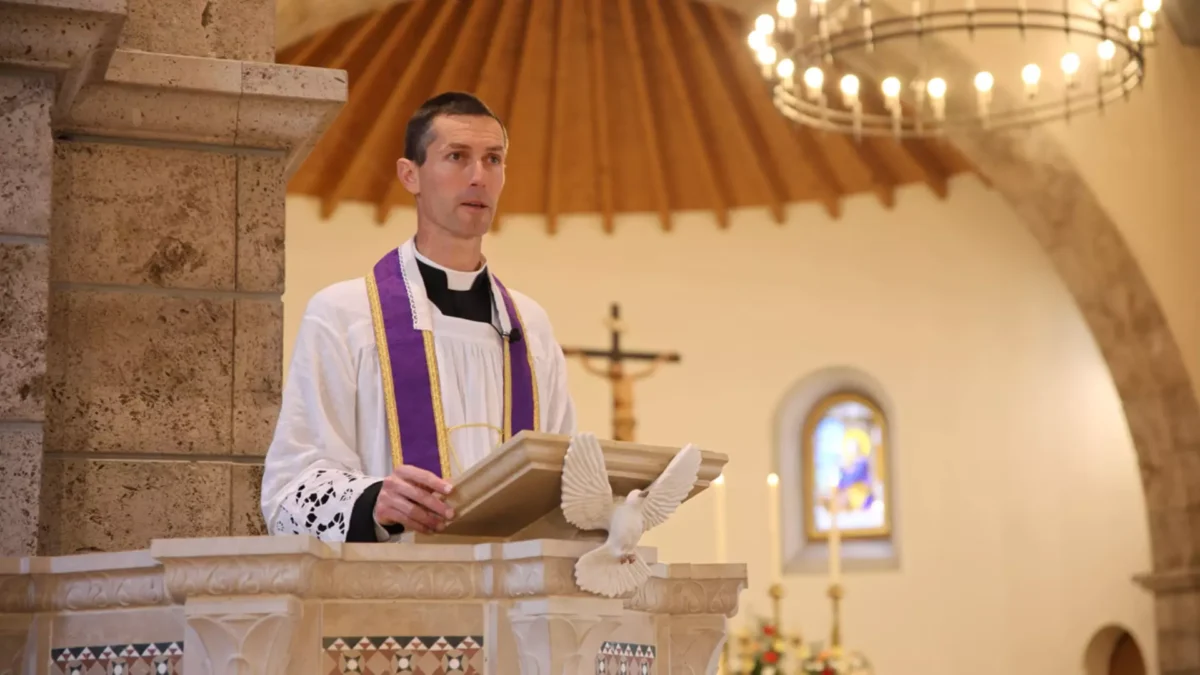
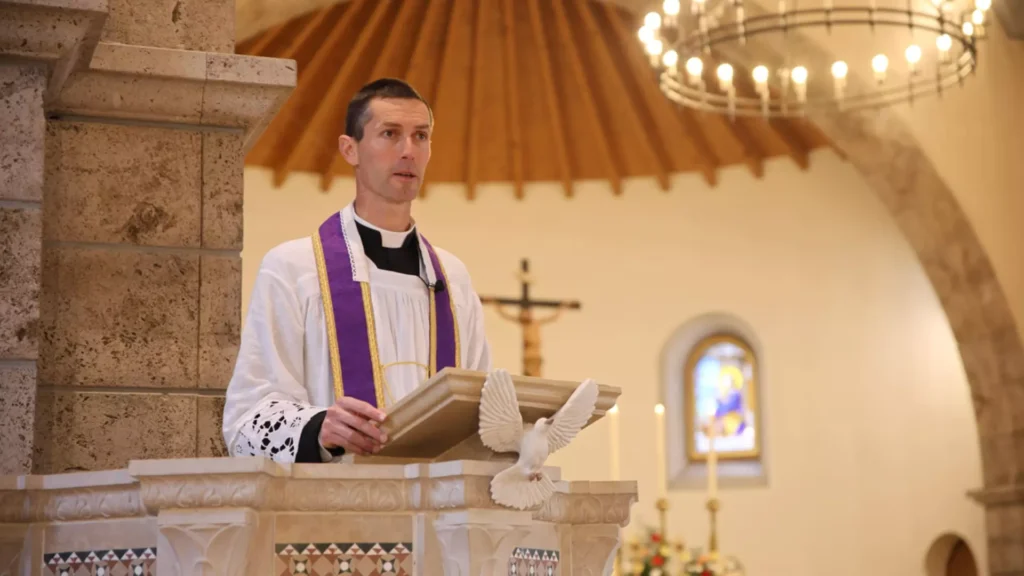
During a sermon delivered on Sunday, February 8, in Ecône, Fr. Bernard de Lacoste, director of the St. Pius X Seminary, explained the necessity of the upcoming episcopal consecrations announced on February 2 by the Superior General of the Society of St. Pius X, Fr. Davide Pagliarani, and scheduled for July 1.
Dear seminarians, dear faithful,
Last Monday, February 2, the Superior General of the Society of St. Pius X announced that there would be episcopal consecrations, that is, the consecration of bishops, on Wednesday, July 1. The ceremony will take place here in Ecône, on the famous Ordination Meadow, in the very same spot where Archbishop Lefebvre consecrated four bishops on June 30, 1988.
This will be a historic event, but it is important to fully understand its scope and significance. The unusual aspect of this ceremony is that, for the moment, it has not received the authorization of Pope Leo XIV. We sincerely hope that the Holy Father will permit these consecrations. We must pray for this intention.
Dealings with Rome
Normally, it is forbidden to appoint bishops without the authorization of the Vicar of Christ, the successor of Peter. This is why our Superior General requested an audience with the Pope several months ago. But alas, this audience has still not been granted. He has written several letters to the Pope and, so far, the only response he has received from the Dicastery for the Doctrine of the Faith is a negative one.
We continue to hope and to pray.
Next Thursday, in four days, Fr. Pagliarani, our Superior General, will travel to Rome at the invitation of Cardinal Fernandez. But this cardinal is not a great friend of Tradition. Therefore, from a human perspective, we should not expect much from this meeting. However, if the Holy Spirit is at work, all things are possible. That is why we must pray with confidence and persistence.
We disagree with those who mock the Pope, who despise the Holy See, and who live as if Leo XIV did not exist. Christ founded his Church on St. Peter and his successors. Love and respect for the Sovereign Pontiff, love for Rome and the Holy See, submission to the Magisterium of the Church – all of this is part of the spirit of the Society of St. Pius X as Archbishop Lefebvre founded it.
A Crisis in the Church
However, alas, we can only acknowledge the fact that for 60 years, those who received from Christ the mission to strengthen priests and the faithful in the faith have been using their authority and power to attack faith and morals. For 60 years, the Holy See has been disseminating confused, ambiguous, and sometimes even false teachings, radically contrary to what the Church has always taught.
If we wish to maintain our faith and state of grace so as to go to Heaven, we are therefore obliged to resist these authorities, not to follow them when they lead us astray from truth or goodness.
Here are some examples of teachings from Rome that we must reject to remain Catholic:
“Non-Catholic Christian communities can be a means of salvation.” False.
“Christ should not reign publicly in societies.” False.
“A divorced and remarried person has the right to receive communion.” False.
“A same-sex couple can receive a blessing from a priest.” False.
“The Old Testament is still in force and has not been abrogated.” False.
“The Virgin Mary should not be called co-redemptrix.” False.
“The Pope is not the only one who holds supreme power in the Church.” False.
“Concern for the climate and the protection of the planet are a priority for the Church.” False.
“Interreligious dialogue is beneficial and fruitful.” False.
“The traditional Mass is outdated, obsolete, abrogated, depassé, antiquated, and ineffective. It no longer meets the aspirations of 21st-century Christians.” False.
“Everyone has the right to live according to their conscience, even if that conscience is mistaken.” False.
The list could go on, unfortunately.
The Need for Faithful Bishops
Cardinal Ratzinger, a few weeks before becoming Pope Benedict XVI, in a meditation for Good Friday, compared the Church to a boat taking on water from all sides. I will use this image to tell you a story that takes place in the middle of the Atlantic Ocean.
A ship has just had its hull pierced and water is starting to come in. Panic! An energetic sailor rushes over to try and plug the holes, to seal the breaches. But the captain intervenes: “No, stay calm, I forbid you to plug the holes.”
Surprised, the sailor reacts: “But Captain, we’ll sink if we don’t do something!”
Nevertheless, the captain remains inflexible: “I forbid all members of the crew to plug even the smallest breach.”
Stunned, unable to understand why his captain was giving such an absurd, incomprehensible, and unreasonable order, the sailor thought for a moment and then decided to disobey. And, with two companions, he set about repairing the ship to prevent it from sinking.
This is intelligent, this is reasonable: it is an image of what the Society of Saint Pius X and its allied communities are trying to do, in their own small way.
Today, in the terrible crisis facing the Holy Church, every Catholic must act to preserve the faith. And members of the clergy must also act to transmit this faith in all its doctrinal purity, with missionary charity.
Now, for there to be faithful priests, there must be faithful bishops. That is why episcopal consecration is required.
The Question of Schism
Some people say, “But consecrating an bishop without the pope’s authorization is a schismatic act.” We must answer this by making a distinction.
If, in this consecration without the pope’s authorization, the new bishops are given the power to govern – or jurisdiction, as we say in the Church – then yes, it is schismatic, because only the pope has the power to grant jurisdiction to bishops. For example, to say, “You, the new bishop, will be Bishop of New York, and you of Paris, and you of Sion.” Only the pope can do that.
In the Society of Saint Pius X, this is not done, and Archbishop Lefebvre never wanted to grant jurisdiction to these four bishops; nor does Fr. Pagliarani. He does not consider himself the Pope.
Episcopal consecrations within the Society of Saint Pius X grant the new bishops only the power of Holy Orders, by which they can administer confirmation, priestly ordination, and consecrate churches; but they will not have governing power over the Holy Church unless the Pope himself grants it to them.
This is why it can be said that these consecrations do not constitute a schismatic act. There is no intention to establish, as the schismatics do, a parallel Church.
Will the Pope react by punishing the new bishops, by imposing ecclesiastical penalties on them? Will the members of the Society of Saint Pius X and the faithful be accused of schism? It is possible.
Yet, we would rather die than be schismatic; we would rather die than live outside the Roman Catholic Church. And if we must suffer in the Church and at the hands of Churchmen, we will remember that the apostles, too, after Pentecost, suffered at the hands of the religious authorities of the time.
Scripture tells us that they were glad to have been considered worthy to suffer for the Name of Jesus. And we ourselves are glad if we are considered worthy to suffer for Christ the King and for His unchanging teaching.
St. Paul warned us: “All who desire to live piously in Christ Jesus will be persecuted.”
Possible Conditions from Rome
It is possible that the Holy See will tell us: “Okay, we authorize you to consecrate bishops, but on the condition that you accept two things: first, the Second Vatican Council; and second, the New Mass. And then, yes, you are allowed to perform consecrations.”
How should we react? It’s simple.
We would rather die than become modernists. We would rather die than renounce the full Catholic Faith. We would rather die than replace the Mass of Saint Pius V with the Mass of Paul VI.
Behind this debate lies the question of eternal salvation. We are on earth to go to heaven. But to go to Heaven, we must be in a state of grace. And to be in a state of grace, we must have faith: it is essential.
St. Paul says: “Without faith it is impossible to please God.”
And to have faith, we must reject all heresies. Now, the worst of heresies is modernism. St. Pius X said: “Modernism is the gathering or cesspit of all heresies.”
Therefore, if we want to go to heaven at the end of our earthly life, we must reject modernism and, to the contrary, preserve the traditional catechism, conforming our lives to it.
When we find ourselves in a difficult situation, hesitating about which path to take, when we don’t quite know what to do, Our Lord gives us, in the Gospel, a criterion for discernment: “A tree is judged by its fruit. A good tree bears good fruit, a bad tree bears bad fruit.”
So let’s look: what are the fruits of the New Theology and the New Mass?
Modern seminaries are emptying; on Sundays at Mass in parishes, one finds mostly elderly people; the numbers in religious congregations are plummeting; morality is no longer respected, etc.
On the contrary, the traditional Mass attracts people, and the only institutes that foster vocations today are those that preserve Tradition.
Let us also look at the fruits among the faithful, among the laity. Where do we find large families? Where do we find spouses faithful to one another and who respect marital morality? Above all – not exclusively, but especially – in communities where Tradition is preserved.
In this church in Écône, for example, there are so many noisy children at Sunday Mass that the noise level sometimes disturbs the congregation and even prevents the priest from concentrating. This is proof of the vitality of Tradition.
Let us conclude with one last remark.
There are communities today that, apparently, while obeying the Pope, maintain the Traditional Mass and catechism. Why doesn’t the Society of Saint Pius X do the same?
The reason is simple. I myself have met and interviewed several of their priests, particularly from the Fraternity of St. Peter. They all confessed to me that they had to be very careful about what they preached in their sermons. Their local bishop is watching them.
They told me, “If I preach against certain modernist errors, I’ll be expelled from the diocese the very next day.”
Which, incidentally, has already happened in several dioceses.
These poor priests, surely full of good intentions, are being silenced. They are not allowed to teach the pure truth. This situation is untenable.
A Call to Prayer
That is why the decision made by Fr. Pagliarani, our Superior General, is reasonable. Faced with a tragic and exceptional situation, exceptional measures are necessary.
Until July 1st, dear faithful, we must pray. We must pray fervently and make sacrifices for Pope Leo XIV. His burden is very heavy.
Some Catholics are content to simply criticize him. This is not very constructive. Let us pray for him. Let us offer sacrifices for the Sovereign Pontiff, that with the help of the Holy Spirit, he may guide the Barque of Peter to the harbor of salvation.
In the name of the Father, and of the Son, and of the Holy Ghost. Amen.
(Sources : Séminaire Saint-Pie X – FSSPX.Actualités)